 Network Tools & Testers
 Cat5e Ethernet Cables
 Cat6 Ethernet Cables
 Cat6a Ethernet Cables
 Cat8 Cables
 Bulk Ethernet Cables
 Connectors & Jacks
 Cable Management
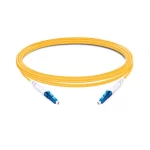 OS2 Singlemode Simplex
 OS2 Singlemode Duplex
 OM3 Multimode Fiber
 OM4 Multimode
 OM2 Multimode
 OM5 Multimode
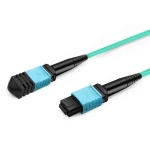 MTP/MPO Cables
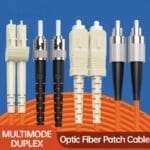 Patch Cables Custom
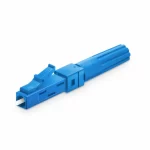 Fiber Optic Components
 Cleaners & Tools
 DisplayPort Cables
 Mini DisplayPort Cables
 HDMI Cables
 HDMI Mini/Micro Cables
 DVI Cables
 VGA Cables
 Audio Cables
 Thunderbolt Cables
 USB-C Cables
 USB 3.0 Cables
 Power Cables
 SATA Cables
 Serial Cables
In network cabling, data center construction and weak current engineering, optical fiber serves as the core transmission medium. Many technicians struggle to distinguish single-mode and multi-mode fiber, leading to signal loss, unstable connection and unnecessary cost waste. This article elaborates their principles, differences, merits and applicable scenarios for correct selection.
1. Basic Working Principle
Single-mode Fiber
Core diameter: 9μm. Only one beam of light travels straight along the fiber axis. It avoids refraction and scattering, featuring low signal attenuation and minimal dispersion for steady transmission.
Multi-mode Fiber
Core diameter: 50μm or 62.5μm. Multiple light beams propagate inside the core via diverse refraction paths. Different travel distances cause modal dispersion, distorting signals and limiting transmission range.
2. Key Parameter Comparison
| Comparison Item | Single-mode Fiber | Multi-mode Fiber |
|---|---|---|
| Core Size | 9μm thin core | 50/62.5μm thick core |
| Transmission Mode | Single straight light path | Multiple refracting light paths |
| Transmission Distance | Kilometer to hundred-kilometer level | Hundred-meter short range |
| Signal Loss | Extremely low | Relatively high |
| Bandwidth | Ultra-high, stable long-distance bandwidth | Limited bandwidth, declines with distance |
| Matching Devices | Single-mode optical module, laser diode | Multi-mode optical module, LED light source |
| Cost | Low fiber price, expensive modules | Slightly costly fiber, affordable modules |
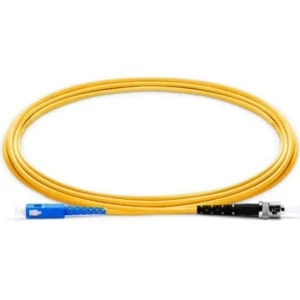
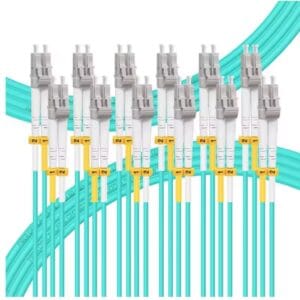
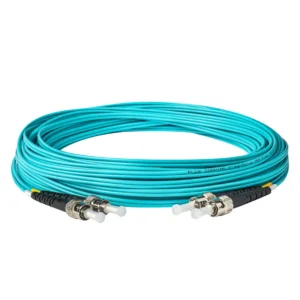
| Outer Jacket Color | Yellow | Orange / Aqua blue |
3. Advantages & Disadvantages
Single-mode Fiber
Pros: Long transmission distance, strong anti-interference, stable signal, huge bandwidth capacity, compatible with 10G/40G/100G high-speed transmission and easy network expansion.
Cons: Strict construction precision required; supporting optical modules cost more.
Multi-mode Fiber
Pros: Easy splicing and wiring with high fault tolerance; low cost for short-distance networking.
Cons: Restricted transmission distance; poor performance in long-distance high-speed data delivery.
4. Typical Application Scenarios
Single-mode Fiber Application
- Carrier backbone network, fiber-to-home broadband access
- Cross-building, cross-zone long-distance wiring and monitoring transmission
- Data center core backbone and long-distance high-speed link
- Remote industrial data and video communication
Multi-mode Fiber Application
- Internal wiring inside data centers and server room interconnection
- Short-range cabling within single buildings and office LAN
- Near-end high-definition video aggregation and local network upgrading
5. Common Selection Mistakes
- Mixed use is forbidden: Mismatched fiber and modules cause severe packet loss and link failure. Keep mode consistent throughout the whole network.
- Multi-mode is not superior in high speed: It only maintains 10G speed within 100 meters, while single-mode supports steady high-speed transmission for kilometers.
- Avoid improper cost saving: Using multi-mode for long distance triggers frequent faults and higher rework cost.
6. Summary
Choose single-mode fiber for long-distance backbone and remote high-speed communication. Pick multi-mode fiber for short-range indoor wiring to cut costs. For distance over 300 meters, single-mode fiber is the reliable priority.